Why is the pond still green when the UV is on?
A pond can be green even while the pump, filter and UV are switched on. Before replacing equipment, it helps to separate three things: what is making the water green, whether the UV is treating it properly, and whether the filter is removing the resulting waste.
We fit and look after pond filtration at That Pond Guy. This article draws on our full pond UV clarifier guide, where you can find the complete product examples, photographs and manufacturer references.
Why is my pond water green?
Green water is usually caused by microscopic, single-celled algae suspended in the water. There may be so many of them that the whole pond looks like pea soup. You cannot pick out each cell by eye; you see the colour of millions of them together.
Algae need light and nutrients to grow. A sunny spell can make a noticeable difference, particularly as the weather warms up. Fish waste, uneaten food, decaying leaves and other organic matter add to the nutrients available in the pond. Soil and fertiliser washing in from the garden can add more. The RHS guide to pond algae explains how sunshine and nutrient build-up encourage it.
That does not mean you have to stop feeding the fish or shade every inch of water. It means checking the obvious sources: are portions being eaten, is waste leaving the filter, have leaves accumulated, and can runoff reach the pond? A UV helps control the suspended algae, while sensible pond care deals with what is feeding the problem.
New ponds can go green while the planting and filtration are becoming established. An established pond can turn green too, especially after a lamp loses effectiveness, a sleeve becomes dirty or the flow through the UV changes. “It was clear last year” is useful history, but it does not rule out a service problem now.
Green water is different from blanketweed
If the water itself is green and you cannot see far into it, suspended algae are likely to be involved. If you can see through the water but there are long strands attached to the walls, plants or waterfall, that is a different problem. A UV only treats water passing through its chamber; it cannot reach around the pond and remove attached growth.
Take a little water in a clear container and look at it away from the pond. This helps separate coloured water from green surfaces underneath it. Brown sediment, disturbed soil and other fine particles can also make a pond cloudy. Our pond algae guide explains the differences, and our blanketweed guide covers the attached strands.
How does a pond UV clear green water?
Inside a conventional enclosed UV clarifier, pond water passes a UV-C lamp protected by a quartz sleeve. The water and lamp stay separate. As the algae pass through, the UV-C damages their cells and interferes with their ability to reproduce. With the right exposure, this stops them multiplying unchecked and helps kill or disable the suspended algae.
The treated cells can clump together, making them easier for the filter to catch. The filter then needs to remove that material from the water, and the collected waste needs cleaning out. That last part matters: the UV has no waste basket of its own. The pond does not become clean simply because the lamp is on.
Think of it as two jobs working together: the UV treats the suspended algae; the filter collects the material that needs removing. Oase explains how UV clarification and filtration work together, while Evolution Aqua’s green-water advice stresses the need for effective mechanical filtration.
Water has to pass through at a suitable rate for the particular unit. Too much flow can leave insufficient exposure; too little flow through the whole treatment circuit means less pond water is being treated. That is why we check the UV, pump and pipework together, rather than choosing on lamp wattage alone.
A UV clears green water; it does not tell you whether the water is safe for koi. It does not deal with ammonia or nitrite, or remove the need to manage waste and feeding. Keep testing the water and looking after the biological filter, even when you can see right to the bottom. If the fish are unwell, use our koi health first checks and ammonia and nitrite advice.
Does every pond need a UV?
No. A planted wildlife pond is managed differently from a stocked koi pond, and a little natural growth is not automatically a fault. For a fish pond where suspended algae are spoiling the view, a correctly chosen UV is a useful part of the filtration. For blanketweed, sludge or unsafe water readings, the main work lies elsewhere.
If green water is the problem you are trying to solve, our pond UV clarifiers are a starting point. The next sections explain how to choose one that suits the pond and the filter you already have.
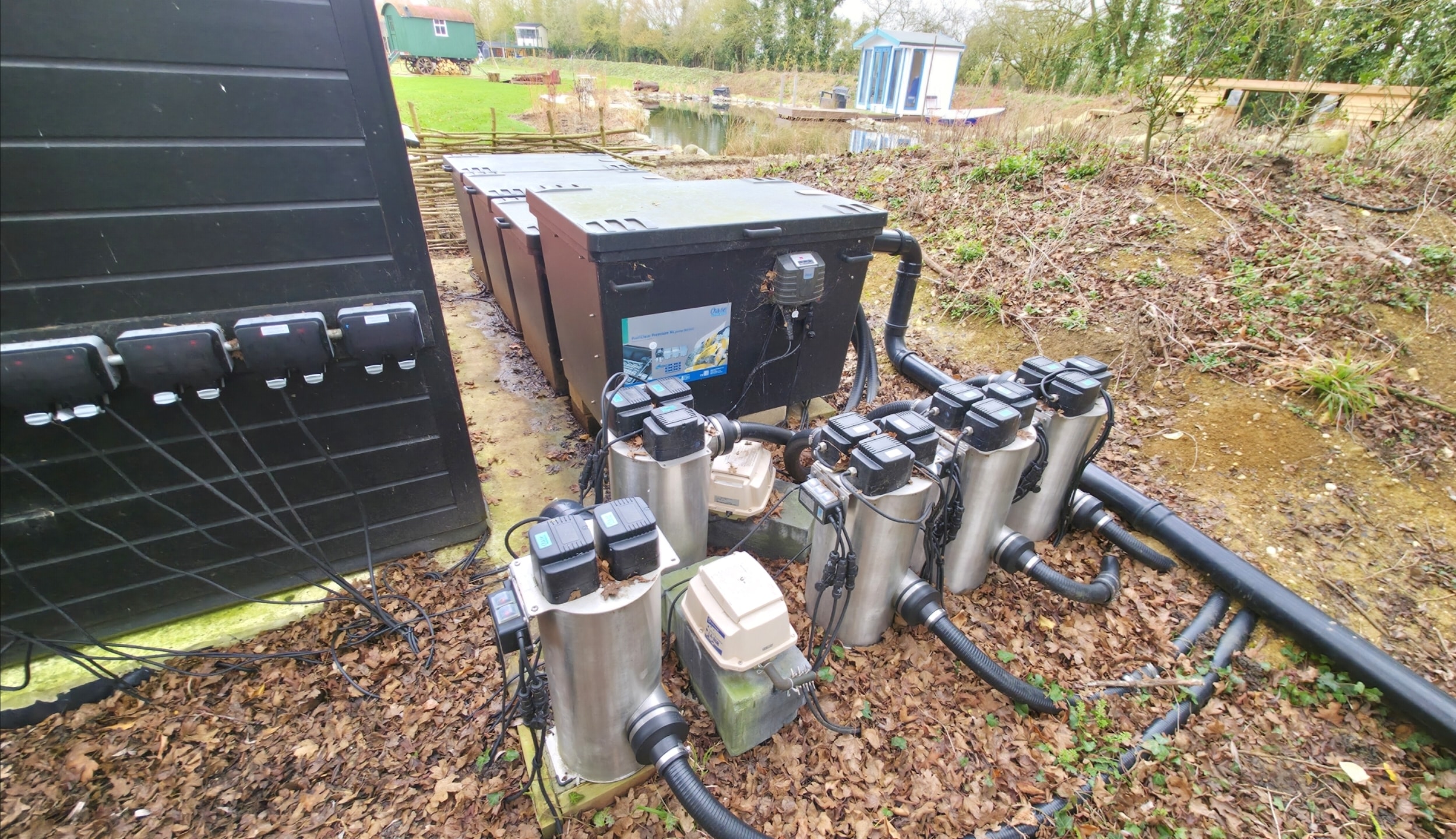
What size pond UV do I need?
Start with a realistic pond volume. If you do not know it, work it out before comparing equipment. A pond with shelves, steps or a sloping bottom holds less than a simple length-times-width-times-depth calculation suggests. Our pond volume guide helps you make a more useful estimate.
Then look at the type of pond the manufacturer has rated the UV for. A decorative pond without fish, a pond with a modest number of fish and a heavily stocked koi pond place different demands on the system. Manufacturers may give separate ratings, and the largest figure is often the one that looks most attractive in a short product listing.
Sunlight, fish numbers, feeding and the rest of the filtration matter too. A very sunny pond with large koi should not be treated as equivalent to a shaded ornamental pond just because both hold the same number of litres. Nor does a UV rating tell you how many fish the biological filter can support.
Pond capacity
- What it tells you: Whether the stated rating covers your kind of pond
- What to avoid: Using the largest ornamental-pond figure for a koi pond
Treatment flow
- What it tells you: How much water the unit is designed to treat effectively
- What to avoid: Assuming a maximum-flow limit is always the preferred treatment flow
Minimum flow and pressure limit
- What it tells you: Whether the planned pipework and pump suit the unit
- What to avoid: Choosing on lamp wattage alone
Connections and installation type
- What it tells you: How it fits the actual filter arrangement
- What to avoid: Buying a filter-matched unit without checking compatibility
Lamp and servicing access
- What it tells you: What you will need when the lamp or sleeve needs attention
- What to avoid: Fitting the unit where the lamp cannot be withdrawn
Read the koi rating, rather than just the biggest number
For example, the Oase Bitron Eco 120 W specification gives different maximum pond volumes: 120 m³ generally, 60 m³ with fish and 30 m³ with koi. That is 120,000, 60,000 and 30,000 litres respectively. Those figures describe this particular model; they are not interchangeable ratings for every Bitron.
The same specification also gives a 10,000 litres per hour minimum flow and a 50,000 litres per hour maximum. A unit can have a large pond rating and still be unsuitable for a small, slow-flowing installation. Check both sets of figures.
Why the flow through the UV matters
Think about the water actually passing through the clarifier. The number printed on the pump describes its performance under stated conditions; it does not tell you exactly what will arrive after the pipework, bends and changes in height.
If you are choosing a pump at the same time, use our pond pump sizing guide. It explains how to read the pump information without expecting the maximum figure to be what the finished installation delivers.
Some UV manufacturers give an optimum flow as well as a maximum. The Evolution Aqua evo55, for example, lists an optimum of 15,000 litres per hour and a maximum of 20,000 litres per hour. Use the optimum figure when comparing that model with your proposed flow. Do not choose a pump simply to push the maximum possible volume through the unit.
The evoUV Ti manual lists the same 15,000 litres an hour optimum and 20,000 litres an hour maximum for the evo55Ti. Choosing the Ti version does not mean increasing the flow beyond its instructions. Keep the manual for your particular version with the pond records.
Slowing the water down is not an unlimited solution either. If too little of the pond water reaches the treatment circuit, the system may not do the job you need. A bypass also changes how much passes through the UV. Match the flow through the whole circuit to the UV's instructions. The pump and UV having similar maximum numbers does not make them a suitable pair.
If the plumbing has a bypass, keep a record of its intended setting and the reason for it. An unexplained valve position can make future fault-finding much harder. Never restrict a unit or alter its bypass without checking its minimum-flow, pressure and installation requirements.

Why is my pond still green when the UV light is on?
A glow tells you something is illuminated. It does not tell you that the lamp is still giving its intended UV-C output, that the sleeve is clean or that enough pond water is being treated.
Work through the simple checks before buying a larger unit. Make a note of what you find and change one relevant thing at a time, unless a fault needs immediate isolation. Replacing the lamp, changing the pump and moving several valves together makes it much harder to identify the cause.
The indicator glows, but the lamp age is unknown
- Check first: The lamp record and exact manufacturer's replacement advice
- What that means: Visible light is not a measure of useful UV-C output
Performance gradually worsens
- Check first: Quartz cleanliness, lamp age and water flow
- What that means: Several service issues can look like an undersized unit
Water changed after pump or pipework alterations
- Check first: Actual route through the UV, bypass position and model flow limits
- What that means: The treatment circuit may have changed even though the UV has not
There is lots of suspended waste
- Check first: Mechanical filtration, cleaning and circulation
- What that means: The UV cannot remove the resulting debris from the pond by itself
There are long strands on the walls
- Check first: Whether the problem is blanketweed
- What that means: An attached algae problem needs different management
The fish seem distressed
- Check first: Aeration, circulation and water tests promptly
- What that means: Do not treat fish welfare as a cosmetic green-water problem
Evolution Aqua's green-water troubleshooting advice covers flow, lamp age and the need for effective mechanical filtration. That last point is easily missed: treating suspended algae and physically removing the resulting material are different jobs.
How quickly the water clears depends on the pond, how green it is and the equipment treating it. If the basic checks do not explain it, get the model details, pond volume and plumbing arrangement together before asking for help.
How often should you replace the UV lamp?
Use the instructions for the lamp and unit you actually own. “Change every UV bulb after the same number of hours” is too broad. There are different lamp types, control systems and manufacturer recommendations.
Evolution Aqua evoUV
- Manufacturer guidance: Annual lamp replacement at the start of the season
- Keep this distinction: Follow the correct lamp specification for your unit
Oase Eco 60 W replacement lamp, article 57077
- Manufacturer guidance: Up to 12,000 hours
- Keep this distinction: Its compatibility list covers specific models; it is not every Oase UV lamp
Keep a simple record of the fitting date and any lamp-hours reading. If the unit has a service counter, follow its instructions when replacing the lamp. Resetting a counter without doing the corresponding maintenance only makes the record misleading.
When ordering, have the full model name, article number and lamp details ready. The same wattage does not guarantee the same length, fitting or compatibility. Check the number of lamps the unit takes too; do not assume that the wattage in the unit's name describes one individual lamp.
What is the quartz sleeve, and why clean it?
The quartz sleeve is the transparent barrier around the lamp that keeps the pond water separate from it. Dirt and scale on that barrier can get in the way of the UV doing its job. A new lamp inside a dirty sleeve leaves part of the problem untouched.
Evolution Aqua's maintenance advice includes cleaning the sleeve during the season. Follow the cleaning method in your own manual, particularly where seals, cleaning mechanisms or approved descaling products are concerned. A sleeve is fragile: forcing it, scratching it or overtightening a fitting can turn a routine service into a leak.
Make sure all replacement seals and components are the correct ones. After reassembly, carry out the specified leak checks before restoring the lamp to service. The evoUV manual, for example, specifies a 24-hour water leak test before the lamp is installed. Check your exact model's sequence rather than improvising.
Take the model details with you
Before ordering a lamp, sleeve or replacement unit, note the full model and part numbers, pond volume, filter and pump models, and how the pipework is arranged. A clear photograph of the rating plate is much more useful than trying to identify a unit by its wattage alone.
Never look at an exposed UV-C lamp. Isolate equipment before servicing and follow the exact manufacturer’s instructions. UV-C can injure eyes and skin, and a glowing lamp is not a test of useful UV-C output.
Our full pond UV guide on the That Pond Guy website also covers installation positions, filter-matched units, winter operation, treatment precautions and running costs.


Comments
Post a Comment