Choosing a Pond Pump: Head Height, Flow and Running Costs
Originally published on That Pond Guy: choosing a pond pump.
When someone asks us what size pump they need, the first useful information is usually a sketch of the pond, filter and pipework. The number printed on the pump box tells us only part of the story.
We build, clean and maintain ponds at That Pond Guy, and keep koi ourselves. A pump needs to suit the system it will actually work in. Here are the checks we use to turn a broad maximum-flow figure into a more useful buying decision.
Start with two numbers
The first is the flow your filter or water feature needs to receive, in litres per hour. The second is the operating head: the resistance the pump must overcome to deliver that flow. This includes the lift and losses through pipework and connected equipment.
The question is whether the chosen model can deliver the required flow at that operating head. Comparing maximum flow alone cannot answer it. Maximum flow and maximum head describe different ends of a pump's performance curve; they are not two figures the pump delivers together.
Give the pump a clear job
Is this pump sending dirty pond water into a filter, returning filtered water from a gravity system, supplying a waterfall or running a fountain? Those are different duties. Check that the individual model is suitable for the installation and for the water it will handle.
If one pump supplies two branches, draw both. Water does not automatically split equally. The resistance of each branch and the valve settings affect the split, so changing the waterfall branch can alter the filter flow.
Filter pumps and variable pumps are useful shopping starting points, but a category name cannot replace the model's specification.
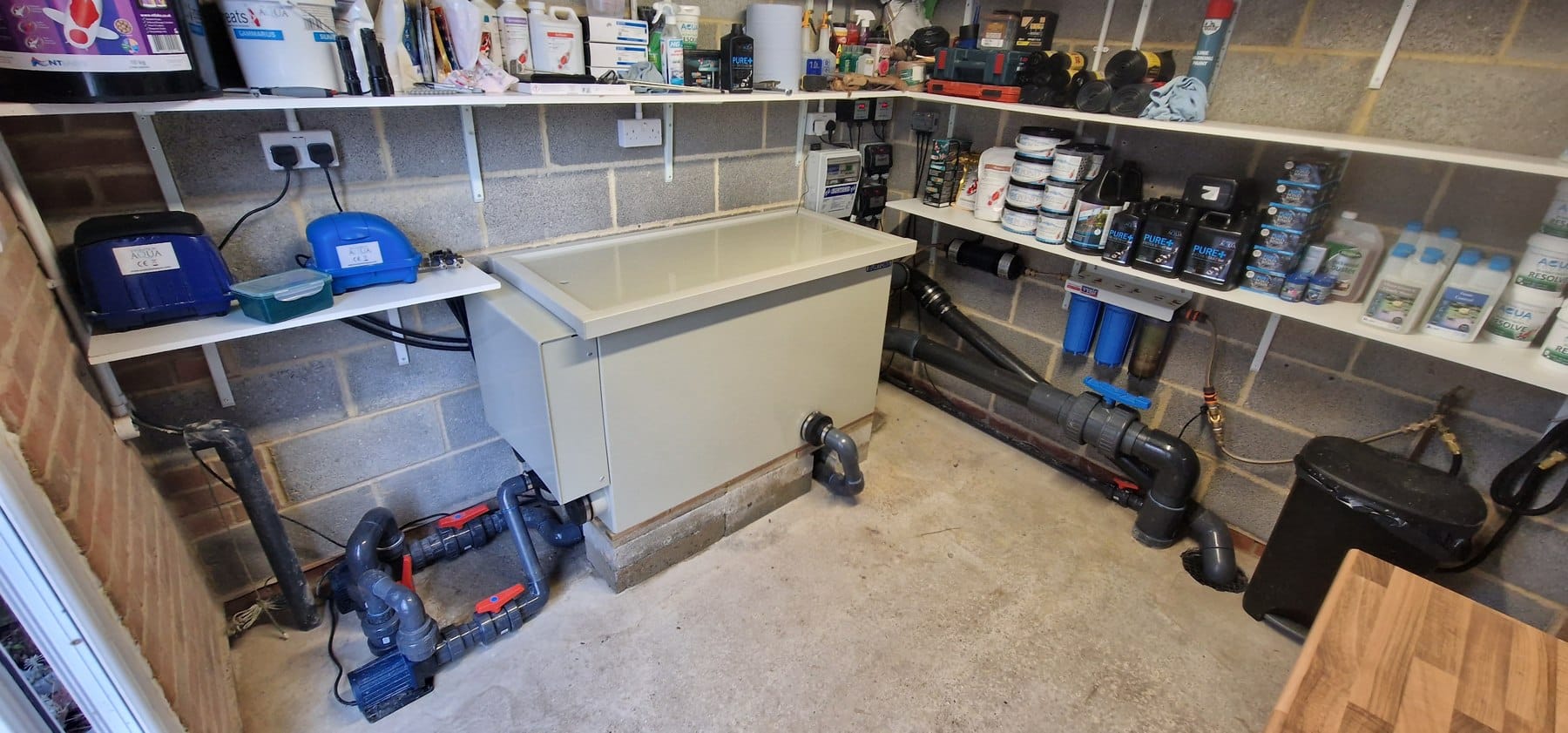
Work out volume, then check the filter
For a rectangular pond, multiply length by width by average water depth in metres, then multiply by 1,000 for litres. A pond measuring 4 metres by 2 metres with an average water depth of 1 metre holds roughly 8,000 litres. Shelves and sloping sides make the calculation less exact. Keep a metered first-fill figure if you have one.
Use the filter manufacturer's operating guidance alongside pond volume, fish stock and feeding. Do not apply one filter's limits to another. Check the UV and any other equipment in the circuit as well.
Dividing pond volume by measured flow gives a nominal turnover time. For example, 12,000 litres divided by 6,000 litres per hour gives two hours. Pond water mixes, so that is not a promise that every litre is individually cleaned once in two hours.
Measure lift from the water surface
For a simple open pond feeding an open waterfall, measure vertical lift from the pond water surface to the discharge level. Measuring from a submerged pump on the pond bottom overstates that static lift.
There are still losses through hose, pipe, bends, valves and equipment. A return close to pond water level does not make all that resistance disappear. Pumps installed above the water they draw from need a separate check of their inlet arrangement and priming requirements.
Oase's total dynamic head guidance explains how lift and friction losses are combined. Keep the units consistent when using a manufacturer's charts.
A worked selection example
Suppose a circuit needs 6,000 litres per hour and has an estimated total operating head of 2 metres: 1 metre of static lift plus 1 metre of losses at that intended flow. These are illustrative figures, rather than a calculation for your pond.
Look at the performance curve for the exact pump model. At 2 metres of head, does it still supply 6,000 litres per hour? If its curve is below that point, its maximum flow rating will not rescue the selection. If a manufacturer does not provide enough information to check the duty, ask before ordering.
The loss estimate needs to reflect the actual pipe sizes, length, fittings and equipment. A narrow or awkward hose run may need improving rather than simply fitting a stronger pump.
Why we like suitable variable pumps
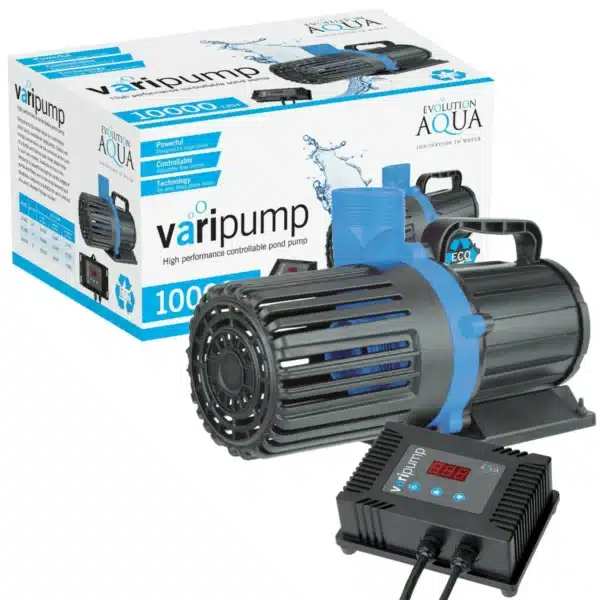
We prefer suitable variable pumps because adjusting the output makes it easier to fine tune a completed system. It can also be useful when a circuit's requirements change. The pump still needs enough capacity at the operating head.
A controller set to 50% is not proof of half the maximum flow, and it is not necessarily proof of half the power consumption. Flow depends on the circuit. Measure it where practical and check the manufacturer's data for how the controller works.
Compare running costs using actual watts
For a pump running continuously, multiply watts by 24, divide by 1,000 and multiply by your electricity price per kilowatt-hour.
Using an illustrative tariff of 25p per kWh, a 100W pump costs about 60p per day, or £219 over 365 days. A 50W difference over the same period is about £109.50. Your tariff and operating power may differ; those figures are not a quotation or a promise of savings.
Compare consumption at the output you need, rather than selecting a pump on a low wattage number that may refer to a different operating setting.
Check installation before buying
Read the exact model's instructions. Dry installation, inlet position, priming, electrical connection and controller location are not universal across pond pumps.
Evolution Aqua's Varipump manual, for example, specifies a qualified electrician and an RCD with a rated residual operating current no greater than 30mA. It also distinguishes the pipe connections for different models. Keep the controller where the instructions require it; it is not an underwater component.
Check warranty terms and registration requirements for the exact product. A warranty period is not a guaranteed service life.
Before replacing a pump with weak flow
Isolate the power before maintenance. Check for a blocked intake, kinked hose, fouled equipment, an altered valve position or another restriction. Follow the manufacturer's cleaning instructions. Avoid running the pump dry.
Where the arrangement allows a safe bucket measurement, collecting 20 litres in 12 seconds corresponds to 6,000 litres per hour: 20 divided by 12, multiplied by 3,600. Make sure the test reflects the normal circuit and does not involve disconnecting equipment unsafely.
A filtration pump normally needs to keep biological filtration operating continuously. An ornamental feature may have a different purpose. Winter operation should follow the model's permitted conditions and the pond's needs, rather than a blanket instruction to switch every pump off.
The information that makes advice useful
Before choosing, collect the pond volume, filter and UV models, required flow, lift, pipe size, pipe length, fittings and intended installation position. A few clear photographs and a sketch help us identify the parts that affect the selection.
The full pond pump sizing guide on our website includes more photographs, worked examples and checks for the complete setup.


Comments
Post a Comment